
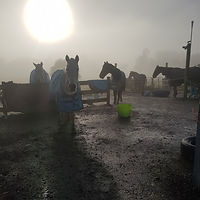
Healing through connection with horses.
The following is a summary of part of the article “Healing with Horses: Equine-Assisted Trauma Recovery” (Sarah Schlote, published in Equine Leadership Magazine, 3rd ed. March 20, 2018)
There is plenty of research showing the benefits of working with animals, specifically horses, for a range of therapies from physical therapy, to healing on an emotional and psychological level.
All mammals have a natural need to find connection through social and emotional relationships. Mammals also have a nervous system that responds to environmental stress in order to keep safe and survive. These responses are often referred to as the 'Fight, Flight, or Fright' response, although there are several more states as well. For wild animals, this state of self-preservation is a direct result of an immediate threat. At the time there is no need for normal function of social relationships, digestion, or respiration. The animal's body directs all energy and strength to the immediate need to survive. Once the threat is gone, the animal can return to a state of rest and regular functions resume. Our Human lives are far more complex and the stresses we experience are often neither immediate nor short lived. We often spend prolonged periods of time in a state of self-preservation. In this state, our nervous system will be firing constantly, preventing normal healthy bodily functions or healthy social connections.
When recovering from trauma, we work through several stages. In stage one, connection with animals can enhance recovery. Animals are great at modelling the importance of empathy, and non-judgement. They can help in the development of an internal focus of control through regulation skills like sensory grounding, self-soothing, mindfulness and self-compassion, amongst others. By spending time together, doing activities that encourage a mutual awareness of each other's (animal and human) needs, both will feel recognized and understood. This can be the kind of relationship that is often completely missing when we are in a survival state, because this state does not support connected relationships in a safe and trustworthy manner. Or the lack of reliable, safe and non-toxic relationships can be a triggering event.
The article, "Healing with Horses" explains that the relationship between the facilitator and horses is also beneficial. By observing the way in which the facilitator attends to the needs of the horses, clients are able to develop a sense that people can be trustworthy, and recalibrate their gauge for safety and danger in relationships.